Kobrea Explorations announced aerial studies on its properties in Malargüe and prioritizes El Perdido as the project where they will focus their initial efforts.
By Panorama Minero
As the exploration season in the Mendoza mountain range comes to a close, El Perdido stands out as the project making the most progress among the 34 that have legislative approval in the Malargüe Occidental Mining District (MDMO), in the southern part of the province.
The Canadian junior company had already announced the identification of areas where they would conduct the first drillings for this project and had also mentioned the start of road construction to access the copper porphyry area. Now, they have confirmed that they will also proceed with a magnetic and radiometric airborne survey carried out by New-Sense Geophysics Ltd. and GeoEnergia Argentina S.A.
The company expects that these new data will complement the historical geophysics, which already suggests the potential of a large copper system emerging at the surface and extending at depth.
However, this study will not only focus on El Perdido but also on El Destino, another property that has exploration permits and is part of seven properties that they negotiated with the Mendoza-based company AgAuCu, with an option to purchase 100% of the properties. In this case, they hope the aerial analysis will help determine the potential size of the porphyry system, which already seems to be significant.
The process, which is expected to be carried out in the coming weeks before the close of the 2024-2025 campaign, involves a magneto-radiometric airborne geophysical study covering 2,245 linear kilometers across the property. The aim is to complete information about the scale, geometry, and intensity of the known alteration systems. Additionally, they seek to delineate potential new porphyry targets within the project boundaries.
In the case of El Perdido, a ground magnetometry survey has already covered the core of the system, so they expect the same airborne study to provide a more complete picture of the geology and hydrothermal alteration beyond the historically defined boundaries. They estimate that the radiometric data will record the surface distribution of potassic alteration and the extent of hydrothermally altered rock.
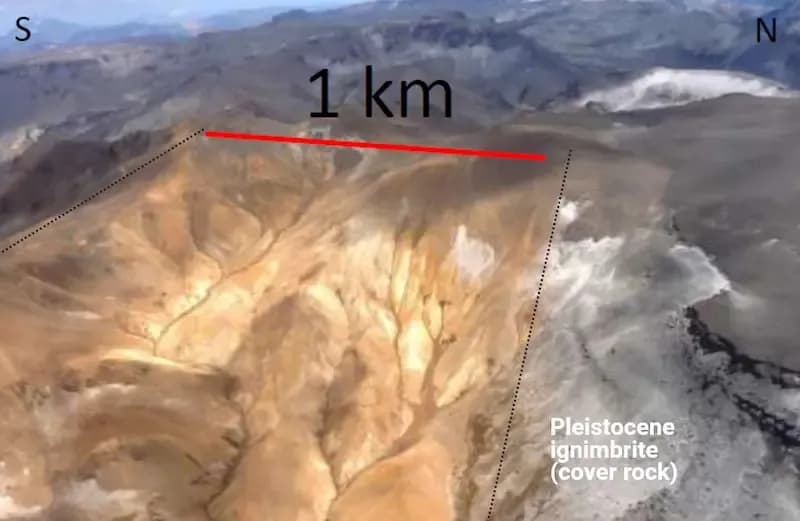
For El Destino, they expect the airborne magnetometer to measure properties beneath the most recent cover rock to define the largest extent of the hydrothermal alteration footprint.
Eastern Mining District
While the process of the first 34 MDMO projects continues and the environmental impact report for another 27 is being analyzed, the Mendoza Government is considering the possibility of creating a new polygon that follows the same structure as the western district but in the eastern area.
Thus, the creation of the Malargüe Eastern Mining District is moving forward in the southeastern part of the department, specifically to the east of the La Payunia Natural Reserve.
The goal would be to add a new mining exploration zone once the number of approved projects in MDMO reaches one hundred. According to the timeline analyzed by the Mendoza executive, they expect to have at least 120 approved projects by the end of the year. This includes the current package of projects undergoing legislative approval and a third set that will be sent once the MDMO II review is completed.
The Eastern district’s structure would be similar to the western one, with Impulsa Mendoza S.A. acting as the promoter for a joint treatment of a series of properties located in a specific geographic area, which would first have a base of environmental and geological studies.