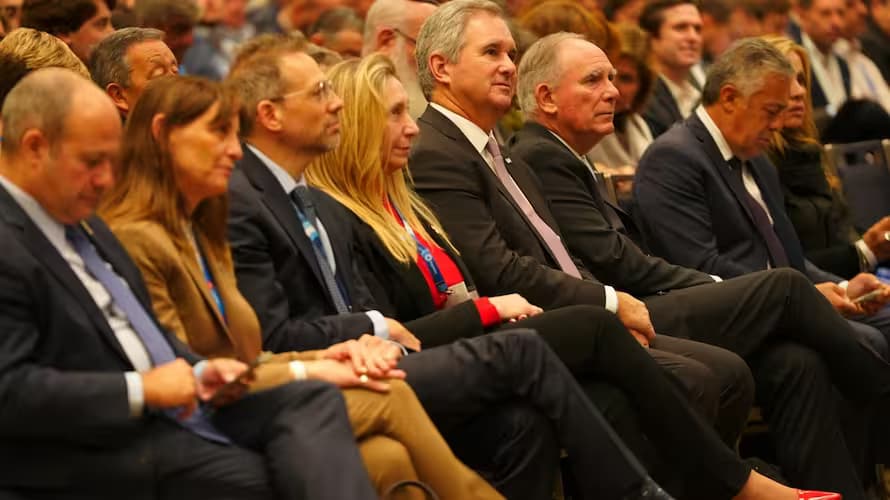
The official delegation was led by the Secretary General of the Presidency, Karina Milei; the Secretary of Finance, Pablo Quirno; and the Secretary of Mining, Luis Lucero. Argentina’s Ambassador to Canada, Josefina Martínez Gramuglia, and Canada’s Ambassador to Argentina, Stewart Wheeler, also attended the event’s opening.
By Panorama Minero
A Day of Speeches and Key Announcements
Argentina Day commenced with remarks from Josefina Martínez Gramuglia, followed by Ambassador Wheeler, who welcomed Canadian investors and emphasized the importance of strengthening responsible mining:
"Contributions to the sector in Argentina and abroad are not only fundamental to our economy but also essential in ensuring that business practices are both economically and environmentally responsible."
Karina Milei then took the stage for one of her rare public appearances. "Many of you know me—I don't speak often—but I want to sincerely thank the ambassadors of both countries, the Federal Investment Agency, the Secretariat of Mining, and the Secretariat of Finance for making Argentina's presence at this remarkable event possible," she stated. She underscored the country's changing trajectory:
"There is a new era in Argentina—there is a before and after. Today, we see a stable and growing economy, and we also see the RIGI law, which I believe is what brings us here today. We can now offer legal certainty and clear rules for investors—something that has been lacking for many years."
Following Milei's remarks, Pablo Quirno provided an in-depth analysis of Argentina's economic and fiscal situation, presenting what he described as compelling figures:
"When President Milei took office in December 2023, Argentina was on the brink of economic catastrophe. We had no reserves at the Central Bank, monthly inflation stood at 25%, and there was a complete loss of confidence in the system."
He explained that tackling the root problem was crucial:
"For decades, Argentina attempted to control inflation with price caps, manage debt crises by restructuring or defaulting, and address the lack of reserves through capital controls. But it never addressed the real issue: the fiscal deficit."
Quirno highlighted that within its first month, the new administration eliminated five percentage points of GDP in fiscal deficit, achieving sustained surpluses.
"We had no credibility. We couldn't ask for the benefit of the doubt. So we had to deliver results quickly. And we did: we achieved fiscal balance in the first month, and today, 14 months later, we continue to maintain a financial surplus every month."
This, he noted, directly impacts private investment:
"With lower inflation and a reduced tax burden, businesses can access financing. In 2023, monthly inflation was at 25%; today, it stands at 2%. Under these conditions, Argentina is once again attractive for foreign investment."
Luis Lucero focused his presentation on Argentina's mining potential:
"Argentina holds 122.4 million tonnes of lithium resources, 90.5 million tonnes of copper, and 3.2 billion ounces of silver, with a more flexible concession regime than Chile and Bolivia."
He detailed the sector's recent growth:
"In the last eight months, installed capacity for lithium production has increased by 40%, and six projects have applied for RIGI inclusion, totaling US$5.4 billion in investment."
Lucero emphasized the broad political support for mining:
"For the first time in years, both national and provincial leaderships are aligned in recognizing mining as a pillar of economic development."
He also noted a shift in public perception:
"Historically, Argentina has had an agricultural identity, often indifferent or even resistant to mining. Today, society understands its importance, which is reflected in unprecedented political backing."
Lucero highlighted international agreements signed by Argentina:
"We have secured memorandums of understanding with the United States, the United Arab Emirates, and Germany, in addition to strengthening our cooperation with the European Union. These agreements aim not only to attract investment but also to enhance technical education in mining regions."
Finally, he underscored RIGI's tax implications:
"The impact of RIGI is clear. According to CRU Group, the effective tax burden on copper mining EBITDA has dropped from 47% to 38%, making us more competitive than Chile (45%) and Peru (42%). Additionally, RIGI guarantees tax stability for 30 years and allows access to international arbitration."
Provincial Debates: The Potential of San Juan and the NOA Region
During the panel Opportunities in Cuyo and Patagonia Provinces, San Juan Governor Marcelo Orrego highlighted copper's role:
"Lithium is tactical, but copper is strategic because it cannot be replaced. Today, San Juan hosts six of Argentina's ten copper projects, and mining represents a crucial opportunity for both our province and the country."

Mendoza Governor Alfredo Cornejo echoed this sentiment, stating:
"We said we would amend the Mining Procedure Code to streamline permitting, and we did."
He also mentioned the creation of the Malargüe Western Mining District (MDMO), a nearly 20,000-hectare area with over 200 mining properties, where 34 projects have already received DIA approval from the provincial legislature.
In the NOA region panel, La Rioja Governor Ricardo Quintela clarified that his attendance was at the invitation of the Federal Investment Council (CFI) and not part of a delegation led by Karina Milei. He emphasized La Rioja's deep-rooted mining history, dating back to 1591.
Jujuy Governor Carlos Sadir highlighted his province's consistent investment framework:
"Mining development in Jujuy has been built on clear rules and a strong relationship with investors. Our goal is to continue fostering responsible mining, with direct benefits for local communities."
The Private Sector's Perspective: Confidence in Argentina
Barrick CEO Mark Bristow praised Veladero's 2024 performance, calling it one of the best in a decade. The mine exceeded 500,000 ounces in production, reaffirming its position as Argentina's top mining exporter:
"Throughout our history, we have generated US$16 billion in exports, with direct economic impact through taxes, wages, and local suppliers."
Bristow also emphasized investment in exploration and optimization to extend the mine's life by at least another decade. He highlighted local procurement programs that have developed over 300 Argentine companies and underscored Barrick's commitment to infrastructure investment.
"We welcome the government's economic reforms and believe in Argentina's potential. We invite new investors to join us."
Austral Gold CEO Eduardo Elsztain stressed that Argentina possesses vast resources, but without financing, these cannot translate into development. He pointed to Argentina's historical currency instability, noting that over the past 200 years, the country has changed its currency five times and removed 13 zeros.
"Stability is key to attracting capital."
Is Argentina Entering a New Mining Era?
Argentina's participation in PDAC 2025 underscored a strategic approach: positioning itself as an attractive mining investment destination. Government backing, macroeconomic stability, and incentives like RIGI were the main arguments presented.
However, the key challenge remains sustaining this new environment over time. While political and business leaders demonstrated commitment, Argentina's history of cyclical economic instability raises questions about the country's ability to maintain clear rules and investor confidence in the long run.
As a major global investor told Panorama Minero:
"Argentina must reinforce the message of maintaining stability and avoiding cyclical trust erosion. These changes must transcend any government or political figure to ensure long-term success. The opportunity ahead is extraordinary—Argentinians must seize it."